 Add to Chrome
 Add to Firefox
 Add to Edge
Emission-Aware Reinforcement Learning for Sustainable Electric Vehicle Charging and Carbon Dioxide Reduction Under Varying Renewable Penetration
May 23, 2026
The rapid growth of Electric Vehicle (EV) adoption challenges power distribution networks through peak load spikes, voltage instability, and transformer overloads from uncoordinated charging. While Model Predictive Control (MPC) and standard Reinforcement Learning (RL) methods have addressed these issues, existing approaches rarely treat real-time carbon intensity or fluctuating renewable energy (RE) availability as primary scheduling objectives, leaving substantial decarbonisation potential unrealised. This paper proposes an emission-aware RL strategy based on the Soft Actor Critic (SAC) algorithm, with a multi-objective reward that penalises carbon emissions, curtailed on-site renewables, and unmet user demand. The agent is trained within a unified benchmarking framework on the EV2Gym platform, incorporating behind-the-meter solar and wind profiles, time-varying EirGrid carbon intensity data, and realistic workplace EV behaviour across 25 Electric Vehicle Supply Equipment (EVSE) units. Nine control strategies, including heuristics, emission-aware MPC variants, and the proposed RL agent, are compared under five renewable penetration scenarios (0%-50%) over ten independent runs each. The RL agent achieves a carbon intensity as low as 23.96 grams of carbon dioxide per kilowatt-hour under 50% wind penetration, representing up to 87% emission reduction versus the uncontrolled baseline, and outperforms the external graph-based Power Distribution Network (PDN) benchmark. Transformer overload remains below 7 kWh across scenarios, against up to 1093 kWh for the As Fast As Possible (AFAP) heuristic, and renewable self-consumption reaches 52% under combined wind and solar supply. Embedding carbon intensity forecasts into the RL state and reward aligns charging with low-emission periods while preserving grid compliance and user satisfaction.

Optimal Real-time Communication in 6G Ultra-Massive V2X Mobile Networks
Oct 08, 2025This paper introduces a novel cooperative vehicular communication algorithm tailored for future 6G ultra-massive vehicle-to-everything (V2X) networks leveraging integrated space-air-ground communication systems. Specifically, we address the challenge of real-time information exchange among rapidly moving vehicles. We demonstrate the existence of an upper bound on channel capacity given a fixed number of relays, and propose a low-complexity relay selection heuristic algorithm. Simulation results verify that our proposed algorithm achieves superior channel capacities compared to existing cooperative vehicular communication approaches.
Energy Detection over Composite $κ-μ$ Shadowed Fading Channels with Inverse Gaussian Distribution in Ultra mMTC Networks
Aug 29, 2025This paper investigates the characteristics of energy detection (ED) over composite $\kappa$-$\mu$ shadowed fading channels in ultra machine-type communication (mMTC) networks. We have derived the closed-form expressions of the probability density function (PDF) of signal-to-noise ratio (SNR) based on the Inverse Gaussian (\emph{IG}) distribution. By adopting novel integration and mathematical transformation techniques, we derive a truncation-based closed-form expression for the average detection probability for the first time. It can be observed from our simulations that the number of propagation paths has a more pronounced effect on average detection probability compared to average SNR, which is in contrast to earlier studies that focus on device-to-device networks. It suggests that for 6G mMTC network design, we should consider enhancing transmitter-receiver placement and antenna alignment strategies, rather than relying solely on increasing the device-to-device average SNR.
Towards Industry 5.0: Intelligent Reflecting Surface (IRS) in Smart Manufacturing
Jan 11, 2022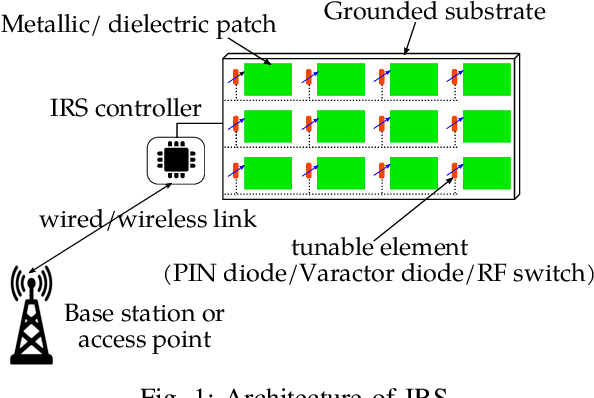
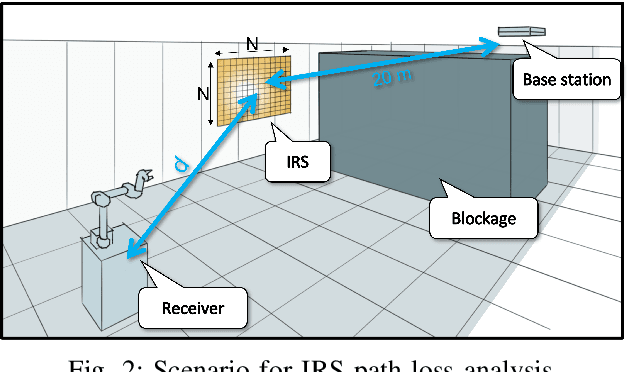
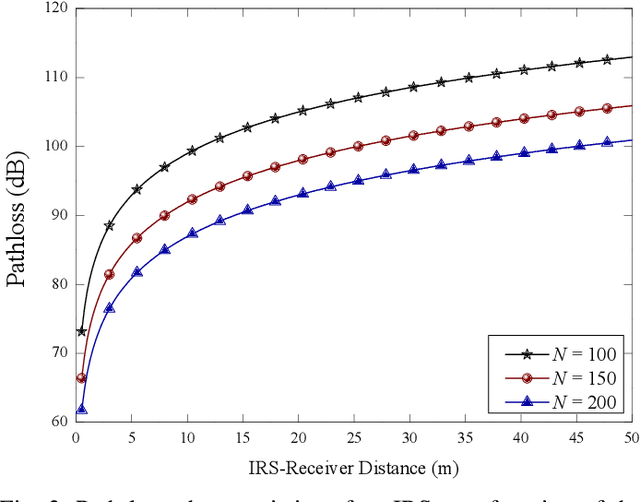
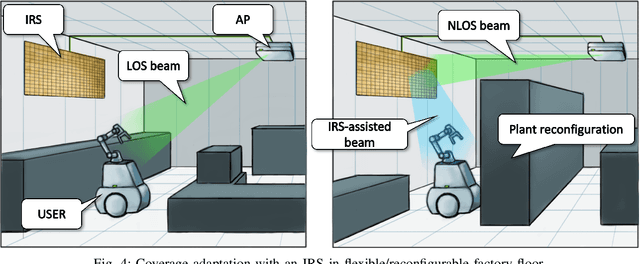
Industry 5.0 envisions close cooperation between humans and machines that requires ultra-reliable and low latency communications (URLLC). Intelligent Reflecting Surface (IRS) has the potential to play a crucial role in realizing wireless URLLC for Industry 5.0. IRS is forecasted to be a key enabler of 6G wireless communication networks as it can significantly improve the wireless network's performance by creating a controllable radio environment. In this paper, we first provide an overview of IRS technology and then conceptualize the potential for IRS implementation in a smart manufacturing environment to support the emergence of Industry 5.0 with a series of applications. Finally, to stimulate future research in this area, we discuss the strength, open challenges, maturity, and enhancing areas of the IRS technology in modern smart manufacturing.
Machine Learning in Event-Triggered Control: Recent Advances and Open Issues
Sep 27, 2020Network Control Systems (NCSs) have attracted much interest over the past decade as part of a move towards more decentralised control applications and the rise of cyberphysical system applications. Many practical NCSs face the challenges of limited communication bandwidth resources, reliability and lack of knowledge of network dynamics, particularly when wireless networks are involved. Machine learning (ML) combined with event-triggered control (ETC) has the potential to ease some of these challenges. For example, ML can be used to overcome the problem of a lack of network models by learning system behaviour or adapt to dynamically changing models by continually learning model dynamics. ETC can help to conserve bandwidth resources by communicating only when needed or when resources are available. Here, we present a review of the literature on work that combines ML and ETC. The literature on supervised, semi-supervised, unsupervised and reinforcement learning based approaches such as deep reinforcement learning and statistical learning in combination with ETC is explored. Furthermore, the difference between the application of these learning algorithms on model-based and model-free systems are discussed. Following the analysis of the literature, we highlight open research questions and challenges related to ML-based ETC and propose approaches to possible solutions to these challenges.